Showing posts with label walk a tiger tour. Show all posts

Thursday, May 9, 2013

My impressions of the Baja Desert


My impressions of the Baja Desert

In the newsletter today, I want to talk about the desert areas we pass through as we drive to and from the lagoons of Central Baja. I usually talk about the whales in these newsletters. This time I will say something about the desert and the mountains of Baja. We travel through this desert week after week as we bring people south to see the whales of Mexico.

This narrow region of hot desert mountains visually characterized by huge rock gardens and dry stream beds stretches 120 miles east to west, from the Pacific Ocean to the Gulf of California and 1,000 miles north to south. It has mountains, sandy white beaches, high and low desert, bustling industrial towns and remote villages without electricity.  There are mines that have been chiseled deep into raw rock and factories along the border that produce everything from auto parts to kids toys.  There are areas so remote they have remained unchanged for thousands of years.  There are resort hotels with swimming pools where the guests float in heavily chlorinated fresh water while viewing the salty Pacific Ocean just a few steps away.

In this newsletter I will only look at Central Baja, where there are no large concentrations of people.  This area of few towns and a population of about 50,000 people stretches across an area over 700 miles long. Beginning at the small village of Socorro just south of San Quintìn the area I think of as Central Baja continues south to Ciudad Insurgentes and spans both Baja California Norte and Baja California Sur.

Much of the moisture that the plants and animals survive on in this region is deposited on the plants and rocks during the fog shrouded nights that are a regular phenomenon throughout much of the year in Central Baja. All along the Pacific coast of California and Baja California a vast layer of low lying marine clouds seems to always hang just offshore.  In the evening this marine layer moves in over the shoreline covering all exposed surfaces with a cool moist layer of dew.  Mice, insects, plants and birds obtain some of their water from this moisture.

As we drive south on our whale watching trips that depart from San Diego, the scenery undergoes radical changes.  The bustling frenetic energy of the border towns of Tijuana and Ensenada is replaced by the more serene, but highly productive agricultural industry.

We pass thousands of acres of cultivated farmland.  These fields are tilled and manicured month after month, year after year to produce an unending supply of tomatoes, peppers, onions and other assorted vegetables that go from the field to tractor trailer rigs to the dinner tables of Americans in the USA.  San Quintìn is a large town, getting bigger, that marks the end of this agricomplex.  Now we see the scenery begin to change from rolling oak and grass covered hills to the rugged desert I’ve grown to know and love.

The roadside rest stop at Cataviña is in the mountains at an elevation of about 2,500 feet.  The town grew up near a spring known for centuries to the native Indians who populated this desert, long before the Spanish padres began building missions in Baja.  This tiny village survives on the money spent here by people driving the highway north and south.  Just a few years ago, Catavina was an essential gas stop.  Now, with new stations in El Rosario and Villa Jesus Maria, it is possible to drive right by without even thinking about gas.

There are thousands of Cardon Cactus dotting the landscape surrounding the town of Catavina.  A look alike to the southwest Saguaro Cactus these slow growing plants live over 100 years.  Slow growing to a height of 30 feet, the tall frame is supported by a hidden hardwood core.  Cardon wood is used by ranchers for corrals and buildings.

At first sight this land seems barren and lifeless. A typical first impression is that there is nothing here except cactus and rocks and of course the ever present turkey vultures soaring high overhead. Nothing could be further from the reality. This land is teeming with life.

The oceans that surround this desert peninsula are well known for the abundance of fish they contain. Fishermen from around the world dream of traveling to Baja for at least one great fishing adventure! The land has its share of wildlife, too.

On the way home from Guerrero Negro one morning, I stopped in the mountains just north of Catavina to stretch my legs. There, where our ride down trips stop for lunch I decided to climb up to the cave painting site that I hadn’t been to for several months. My good friend, the Indian cave guide Alex was back after a brief stay in the hospital and had a new palapa style home half finished.

I talked with Alex about his new home and then walked alone up to the cave paintings.  I sat quietly for two or three minutes admiring the blossoming scenery around me.

The Elephant trees were in bloom.  The flower is not colorful, but the insects seem to find them anyway.  There was a ribbon of blue and yellow wild flowers running alongside the highway paving.  The colorful flowers that were bright yellow or a nice shade of pale blue as I drove south a few weeks earlier were fading now.  The cardon cactus was about to bloom.  Dozens of green appendages sprouted near the top of each cactus.  The flowers sprouts grow mainly on the west facing side of the plant.  The pitaya cacti were loaded with green fruit that ripen by mid-August or early September.  The cirrio trees were as full of life as I’ve ever seen them.  The top notch of every cirrio was crowned by a starburst of blossoms.

The heavy winter rains of the year past caused the desert to bloom with life.  With more green plant life growing, the fauna increased noticeably.  The population of rabbits and kangaroo rats had doubled or quadrupled.  This undoubtedly would lead to an increase in coyote and cougar populations later.

Sitting up on the big rounded rocks by the cave site my senses gradually slowed down, following my quick drive up the peninsula.  As the vibrations from the road slowly subsided, my fingers uncurled from the shape of the Suburban’s steering wheel. I felt myself come into sync with the just awakening desert.  All around me there were animals moving in search of an early morning meal.

Across the road I noticed a cottontail nibbling on some tender green shoots that were just beginning to sprout. Then there was a flock of 25 small birds pecking at the ground near the rabbit. I was too far away to identify what type they were or what they were eating.  Nearer to me, hundreds of large red ants swarmed from an anthill to harvest food scraps stuck tight to a paper plate that had been carelessly discarded by a previous cave painting explorer.

Overhead a pair of midnight black ravens cruised north, following the highways’ white striped centerline.  The clever ravens have learned to search for crushed insects and the occasional rodent to be found early in the morning on the highway.

Drawn from my momentary study of the many critters searching out their morning meal by the deep rumble of a diesel engine, I turned and watched a heavy tractor trailer rig creep by in slow motion. The driver shifted gears, gashing the metal teeth together, slinging Spanish curses out into the morning air while he fought his ancient rig to get up the momentum needed to carry him over the steep incline that is the road north from Catavina.

His noisy passage broke my quiet contemplation of the land around me.  I thought back on the days past when Cataviña was nothing more than the La Pinta hotel and a Pemex station.  In the last 20 years an entire community has grown up here as I’ve zoomed by.  There’s now a police station, city hall building and dozens of other stores and houses scattered about.  There’s even a new and very strange dome house that was just built north of town and has a sign saying it is a museum.


Looking at the many graffiti covered boulders off in the distance I continue to believe that it is only a matter of time before someone defaces this ancient cave that I’m sitting just outside of.

Thankfully my thoughts were pulled from those unpleasant thoughts by a ruby throated hummingbird that darted from my left side to hover momentarily in place while she sipped nectar from a yellow wild daisy. She moved on and was replaced by a string of honeybees. I watched a stream of these yellow and black insects move to and from a narrow black crack up high on the rocky hillside. Near the entrance to the honey drop a fat horned lizard lay sunning himself in the brisk morning air. The time was 6:35 A.M. and the temperature was 41 degrees Fahrenheit.

A fuzzy black fly landed on my cheek and brought me back to the moment at hand. That was one animal too many for me. I waved the irritating critter away and climbed down the hillside returning to the Suburban. The knobby tires rumbled as I bounced onto the newly re-paved highway, quickly getting up the speed necessary to pass the still struggling big rig that I had observed from atop the Cave hillside.

Two or three miles down the road I got a clear stretch and passed the smoky truck.

It is true that life is hard here. Whether living in the mountains or on a sandy shore side beach every creature must work at survival. Alongside the road ahead of me a trio of vultures squatted down protectively as I roared past them and the remains of an unfortunate cow. There are few fences along this highway. The range cattle roam freely, constantly returning to the string of green plants that grow along the pavement of the highway where the nighttime dew runs off and provides irrigation for this foliage upon which the range cattle feed.

There is more diversity of life forms in this desert than most people realize. After traveling through this dry region just once none of us are surprised to learn that there are over 80 species of cactus to be found up and down the length of the Baja peninsula. But to be told that there have been 192 species of bird identified in the Baja Peninsula region is a big surprise to most people.

One of those birds is fairly common here and that is the roadrunner.  Although I didn’t see one on this trip, last month I saw one sprint across the road with a dead snake in its mouth.

Although I haven’t seen a rattlesnake in more than 10 years, I always advise my fellow travelers to tread carefully lest they disturb a sleeping rattlesnake. All told there are 43 reptilian species (and dozens of sub-species) present in the Baja desert.  Although primarily dry desert there are 4 amphibian species found here.

The morning was still too cool, so I hadn’t seen many reptiles moving around.  Sometimes with a little luck we can spot a desert iguana or a chuckwalla.  The vegetarian chuckwallas are the largest lizard in the Baja Peninsula.  Their favorite food is yellow flowers.  I have smelled and tasted several different flowers that I’ve seen chuckwallas eating and they have all had different flavors.  I don’t know what it is about yellow flowers, but it’s almost comical to see one of these large lizards sprawled in the middle of a clump of green foliage with bunches of yellow flowers stuffed in its mouth.

Included among the 69 species of mammals found on the Baja Peninsula is one of my favorites, the kangaroo rat. Those of you who have camped on the shore at Laguna Ojo de Liebre have certainly seen one or two of these interesting rodents early in the morning or late in the evening. When I used to camp on the shore regularly, I loved to wipe the sand smooth around my camp, place a few flakes of oatmeal on the sand, then in the morning I would marvel at the hundreds of tiny rodent prints left by these industrious mice.

Kangaroo rats are nocturnal animals that live in shallow burrows.  They have cheek pouches for storing the seeds that are their primary food. They are all well adapted to living in the dry Baja Desert environment since most of them never need to drink water. They have super-efficient kidneys that can conserve water by concentrating their urine.  This small and prolific animal is an important food source for coyotes, bobcat and owls.  If you see them in the night, hopping across the roadway you probably will not be able to tell that their tail is longer than their body.

In addition to the native endemic species, there are some newcomers.  One interesting and successful transplant was brought to the peninsula by the whaling ship captains.  This is the Osprey or Sea Hawk.  Here’s one raptor that doesn’t eat mice. Guerrero Negro has many osprey nesting on manmade perches placed atop light buoys and power poles all around the town.

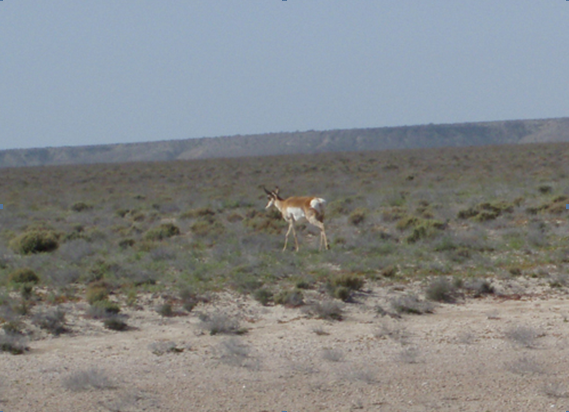
Central Baja is home to a small endangered population of less than 200 pronghorn antelope. Near the town of Vizcaino, which is located inside the Vizcaino Biosphere Reserve there is an important antelope preservation project underway. The biosphere reserve has set up a breeding area intended to add to the sparse pronghorn antelope population.

It’s interesting to note that the wild pronghorn antelope are so reclusive that from one year to the next, when the biosphere reserve biologists attempt to take population counts, the number can vary by several hundred percent. One year they may only count 30 or 40 and the next year nearly 200.

Many of the cave paintings found in Baja contain depictions of the antelope. Recently I was thumbing through a book of photos of Baja wildlife when I came across several images of the pronghorn antelope. The photos were made from an aircraft flying at low altitude.

I was instantly struck by the startling resemblance between the photographic image of the antelope herd running and some of the primitive rock paintings I have seen on past trips. I will never again view those ancient drawings as "primitive". The rock artists have captured the spirit of these antelope perfectly! That photo is the glaring proof of my own narrow minded preconception about the rock paintings. Those early painters obviously knew the antelope with an intimacy that I will never know.

The gray whale has been given many nicknames over the years.  One of them is “the desert whale”.  Since these friendly giants live three months each year inside lagoons that are surrounded by this desert environment, they too might be considered a part of the desert ecosystem.

Where else, but here in Baja, Mexico can a person sit on a remote desert shoreline and watch whales spout just a few yards away.

A different version of this newsletter was first printed in 2001, revised and then published again in 2005.  It’s been revised and updated to reflect what I've seen on recent trips through Baja.  This time I added information about the Kangaroo rats.

Author Bio:

Keith Jones is the founder of Baja Jones Adventures, Jones Adventures, Tigress Tours in Thailand and Butanding Tours in the Philippine Islands and has led thousands of people to Mexico and other interesting locations around the world. He specializes in gray whale tour, blue whale tour, gray and blue whale combo tour, giant panda bear tour, walk a tiger tour, shark tour, African safari tour, African gorilla trek, arctic narwhal tour and Magdalena Bay whale watching tour. He also writes about Baja travel and gray whales. Keith Jones is the author of Gray Whales My Twenty Years of Discovery.

Friday, February 22, 2013

The Mountain Lion: Puma Concolor (Puma & Cougar)


The Cougar is a tan yellow shaded cat whose range is all across North & South America including Baja.

Size:  averaging 100 to 225 pounds, this is the world’s 4th largest cat.  A length to 5’6” and height of 24 to 36” at the shoulder.  Powerfully built and agile as a house cat, cougars can leap 15 to 18 feet vertically to climb a tree.  They can leap as much as 40 feet horizontally. The fastest animal in North America with short bursts of speed to 40 mph.

Prey: A generalist who will eat deer, mice, rabbits & even insects, but not plants.  Cattle, goats & antelope are also prey in Baja.  Large meals generally consumed once or twice a week. 
                                                    Page
Reproduction:  Non seasonal like house cats.  Litters normally every other year. 
Gestation:  90 to 95 days
Cubs weaned: 4 to 6 weeks of age.
Normal is 1 or 2 cubs, but litters to 6.
Cubs stay with mom for up to 2 years growing and learning to hunt on their own. Then they leave and must find a new territory of their own.


                                                                                     Photo: Wikipedia

  The largest purring cat! 


Pronghorn Antelope


About the Author:

Keith Jones is the founder of Baja Jones Adventures, Jones Adventures, Tigress Tours in Thailand and Butanding Tours in the Philippine Islands and has led thousands of people to Mexico and other interesting locations around the world. He specializes in gray whale tour, blue whale tour, gray and blue whale combo tour, giant panda bear tour, walk a tiger tour, shark tour, African safari tour, African gorilla trek, arctic narwhal tour and Magdalena Bay whale watching tour. He also writes about Baja travel and gray whales. Keith Jones is the author of Gray Whales My Twenty Years of Discovery.

Wednesday, February 13, 2013

What's In My Carry Bag


Beginning in the top left corner of the photo and working clockwise.


A lightweight sport windbreaker that rolls into a small roll to slide into the bottom of the backpack I use as my carry on bag.

Small tube of roll on waterproof sunscreen spf 50
Tictac breath mints
Cell phone
Headlamp

Small Ziploc baggie with toilet paper and napkins folded in it.
An empty Ziploc is also inside that to hold my dirty socks if I change socks on the plane.
Also inside the T.P. baggie are a few IBprofen, a couple Imodium AD and a couple tagament. 
Extra pair of warm clean dry socks

Can of Pringles
Crushable foldable hat.  Sunglasses inside a hard shell carry case.  When traveling from Asia to USA or back I customarily put the hat and sunglasses in my checked bag.

My laptop inside a cushioned case that slides into a cushioned pocket in the backpack.
I usually carry the charger and cord which fits into a pocket in the cushioned carry case.

A money bag that can hang from my neck, but normally just lays in the bottom of the backpack.  Inside this bag is money from the countries I’m traveling through, extra passport size photos for visas, my frequent flier cards, California drivers license.  My passport when traveling is in a special easy to access pocket in the backpack or in my shirt pocket.

A small but really terrific Kodak video camera that is waterproof to 15 feet. 
The camera I used to take these photos which is a Canon Power shot A3100.

A thermal cup with lid ($1.00 at 7-11)
Inside the cup I carry a Ziploc baggie filled with sweetener and tea bags.   You can usually get hot water for free.  With the large cup you can actually drink some tea, not just have a sip or two like you get with those tiny airline cups that they only fill halfway.
Sometimes I add a couple Snickers bars to this bag.

A notebook and several pens in different colors with gel ink so the ink doesn’t run when my notebook gets wet.

My Kindle Ebook reader.  I still use their simple black and white model because I only use this for reading books.  This and my laptop are two of the most important things I carry.

Sometimes I carry maps in the carry on if going somewhere new for me.


About the Author:

Keith Jones is the founder of Baja Jones Adventures, Jones Adventures, Tigress Tours in Thailand and Butanding Tours in the Philippine Islands and has led thousands of people to Mexico and other interesting locations around the world. He specializes in gray whale tour, blue whale tour, gray and blue whale combo tour, giant panda bear tour, walk a tiger tour, shark tour, African safari tour, African gorilla trek, arctic narwhal tour and Magdalena Bay whale watching tour. He also writes about Baja travel and gray whales. Keith Jones is the author of Gray Whales My Twenty Years of Discovery.

Friday, January 18, 2013

Searching For the Cheapest Massage In Bangkok


About the Author:

Keith Jones is the founder of Baja Jones Adventures, Jones Adventures, Tigress Tours in Thailand and Butanding Tours in the Philippine Islands and has led thousands of people to Mexico and other interesting locations around the world. He specializes in gray whale tour, blue whale tour, gray and blue whale combo tour, giant panda bear tour, walk a tiger tour, shark tour, African safari tour, African gorilla trek, arctic narwhal tour and Magdalena Bay whale watching tour. He also writes about Baja travel and gray whales. Keith Jones is the author of Gray Whales My Twenty Years of Discovery.


This wasn’t the best Thai massage I have ever had, but it was the cheapest.  After months of searching and hundreds of Thai massages, I had finally found the cheapest massage in Thailand. 

Every visitor to Thailand has heard of Thai massage.  Most visitors plan to get at least one good massage while in Thailand. 

Given my slightly obsessive-compulsive personality, I couldn’t just come to Thailand and have a good massage at my hotel and pay the $10 or $15 dollars there.  No, I had to go out and look for the best massage in Thailand! 

My search for the best Thai massage eventually came to an unimpressive end after two weeks of trial massages, when I finally conceded that almost every massage seemed like the best one at that moment. 

But I couldn’t just drop the massage quest.  My OCD driven quests never end so easily.  Buried deep inside my brain lives a complex psychic trigger that once released cannot be reset.  Unwillingly and against my more rational thoughts, I knew that I would continue some kind of massage quest until the end of time, unless I achieved a satisfactory goal.

For several weeks while I worked, played and explored different parts of Thailand, it seemed there was to be no final outcome to my quest for the best massage.  With my OCD driven impulse left unfulfilled I would most likely sink into a serious case of the psychic doldrums.  An unrelenting feeling of something undone, much like that feeling you get as you drive away on vacation, but then 30 minutes from home wonder if you have left the iron on or the gas stove on, would nag at me until I resolved the massage issue.

I was busy working in Bangkok, but the OCD placed a subtlety relentless pressure on me.  I found myself suddenly turning from my current task at hand, to enter some massage shop I happened to be passing.  I had only the barest control over this impulse.

One massage in a day was no longer enough.  Two massages in the same day barely suppressed that nagging at the back of my brain.  Three massages led to four.  My body began to feel like a piece of tenderized meat.  When I lay down on a massage mat, my muscles were so tender from the continual ministrations of one masseuse after another that the very thought of another massage made me want to run the other way.  Two weeks of this and my work began to suffer because of the time I was using each day just lying on massage mats.

One afternoon, around 4:00 PM while on another massage mat in a small roadside shop, it came to me that what I should have been searching for all along was not the best massage.  No, I realized that I should be searching for the cheapest massage in Bangkok! 

After all everyone loves a bargain!  And if every Bangkok visitor wants at least one good Thai massage, then it was a certainty that many visitors had tried to find a bargain massage.  Had they been successful?  I don’t know.  Could I discover that elusive bargain?  I was sure I could do so. 

With that decision made, the unrelenting pressure instantly became just an elusive shadow hanging in a back closet of my psyche waiting to nag at me should I fail in this revised search. 

Lying on that mat while the masseuse pushed and pulled me one way and then another, I imagined where I might find the cheapest massage in Thailand.  I visualized a small shop, located in some seedy, tight quartered part of Bangkok.  Outside the shop, a dozen people would be standing on line waiting their turn to get cheaply pummeled and twisted.  But, as with most things in my life, the expectations and the reality didn’t quite match.

The most expensive massages in Bangkok are found at the more exclusive hotels and resorts.  These four and five star rated hotels all have some kind of beauty salon, spa or health spa.  A good Thai massage at one of these hotels will run you anywhere from 300 up to 2,000 baht or more.  These luxury spas offer aroma therapy, hot stone massage, oil massage, facials and just about anything you can imagine to primp, preen and tone a body. 

The masseuse or masseur is sure to be an accomplished and polished professional.  The salon décor will be tasteful and expensive.  Pleasant Thai or New Age music will play softly in the background.  Given the relatively high price of those salon treatments, that is as just as it should be.  You can’t go wrong with one of those high end massages.  You’re sure to walk away appreciating the fine art of Thai massage.

But once you leave the hotel spa and head out into the real Bangkok, the price of a good Thai massage drops significantly.  The next day, after a morning that included 2 inexpensive massage stops near my hotel, I decided to check one of the bar districts, in an area of Bangkok known as Sukhuvit. 

The Bangkok bar areas famous or infamous, depending on your personal viewpoint, for the sex tourists who come to visit are also home to scores of massage shops.  I figured that anyplace with such a high concentration of massage shops, would also have a few cut-rate shops.

I was now on a tight timetable, so I decided I couldn’t cut back to just one massage a day.  I would try to do two or three massages in a day - maybe even four or five if I could stand the pounding.  With that decision made and feeling oh so good about the new direction of my massage quest, I headed into the heavy traffic that is always present in Bangkok.

The bar district I visited is called Soi Cowboy.  There are loud, brightly lit bars lining both sides of a 500 yard long walking street. . . .and hordes of excited tourists walking or drunkenly staggering their way up the neon lit street.  I knew this wasn’t my kind of place, but for the purposes of research I forced myself to join the throng. 

After wandering around for an hour I decided to try only one massage shop in this area.  I felt out of place here, but since I had come this far, I would carry on.  I chose one shop that on the outside seemed a little bit worn and battered.

Once inside I realized I had opted for a slightly upscale shop with an appearance similar to that of an expensive European or American spa.  The girls sitting around in the dark wood and marble clad entrance lobby were young, wore bright lipstick and sported eye catching jewelry.  Every masseuse was smiling and beautiful. 

There was a glossy brochure on the counter, written in excellent English that listed and described the types of massages available including; traditional Thai massage, oil massage, soapy massage (normally only available in the bar districts), facial massage and foot massage.  After reading the menu of offerings carefully and taking sharp note of the prices, I had to back out of this shop somewhat gracelessly. 

With half a dozen beautiful young women staring at me, I handed the brochure back to the older woman behind the counter, shaking my head no as I turned away.  Blushing and feeling a little bit like a shy teenager who has just been turned down when asking a pretty schoolmate for a date, I slouched out the front door and moved quickly down the street, until the shop was just a distant memory and my red face had dimmed to a normal tanned color. 

I had cheap massage on the brain, not a sexy 500 baht massage.  I couldn’t afford to waste my precious massage time on such an overpriced massage, even if delivered by a beautiful masseuse with a dragon tattoo on her left thigh.  Deciding the bar street hadn’t been such a good idea, I flagged a passing taxi.

I asked the driver to take me to a healthful massage shop.  He smiled and I could tell that he didn’t understand me.  But he nodded his head and then whipped a sudden U-turn across the two tight lanes of traffic, leaving the sound of squalling car horns echoing down the narrow soi behind us.

Quickly I speed dialed my trusted Thai translator.  I shouted into the phone, “Onanong, quick tell the taxi driver I need a healthful massage shop”.  She is used to getting these unexpected calls from me and simply replied “Okay”. 

I handed the phone to the driver.  A quick Thai conversation ensued.  He just said “kah, kah” (meaning yes,) as Onanong explained where to take me.  Eventually he closed the cell phone and without looking at me, began weaving his way through the heavy Bangkok traffic.

Ten minutes later we pulled up in front of a small massage shop on a typically seedy Bangkok commercial street.  A sign in both Thai and English read “Healthful Massage”.  Onanong had taken me literally at my word. 

To the left side of the massage shop was an open air store that advertised canvas work.  Half a dozen workers sat inside the shop, in front of industrial sewing machines, working away at huge pieces of bright yellow canvas, while smiling, laughing and obviously enjoying their work.  It was a very colorful shop. 

On the other side of the Healthful Massage shop was a store that displayed jars filled with preserved snakes, frogs and strange twisted roots.  Each jar in the store window contained a different plant or animal part and held about three gallons of liquid.   Some jars were filled with clear liquid while others were cloudy white or amber or orange.  This street was strictly local Bangkok all the way.  I had a good feeling about this stop.  It just looked cheap.

Still, I entered the shop with a bit of trepidation after my last aborted attempt back at Soi Cowboy.  Once inside instead of half a dozen beautiful masseuses, I saw this shop had two wrinkled old men sitting on a hard straight bench against the back wall of the tiny shop. 

The receptionist was a woman, maybe 65 years old or maybe 105.  Her face was a pattern work of the kind of deep wrinkles that only come from years of hard work outside in the rice fields beneath the harsh tropic sun.  She still had a few teeth, that glistened a frightening brown when she smiled up at me.  The whites of her eyes were red rimmed and had a yellow jaundiced appearance.  I smiled back at her, gave a half-hearted wai and made some hand motions indicating I wanted a massage.

The shop didn’t have a brochure nor a price list.  Although the two old guys smoking stinking Thai cigarettes in the back of the shop made me want to turn and run, this was beginning to look like I might be in the right place.  How expensive could a massage, given by a 72 year old masseur, actually be? 

I jumped in without any further hesitation.  I didn’t understand a word they said, of course.  But it was clear that the soiled sponge rubber mat on the floor in the far corner was to be my massage table.  I took a deep breath and lay down on my back.

I should point out that in traditional Thai massage, the massage is performed with your street clothing on or with a set of loose cotton tops and bottoms, provided by the salon just for the massage. Of course for oil and soapy massages, you must disrobe leaving on only your briefs, which you should cover with a towel that is thoughtfully provided by the upscale salons, and even more thoughtfully not provided by those massage shops near Soi Cowboy.

Unlike European style massages the Thai massage uses no oil or skin lubricants and usually begins with the recipient lying on his or her back.  The masseuse begins on the legs and feet and moves up from there.  The back is not given as much time as in a Swedish massage. 

Traditional Thai massage is performed using a series of pressing moves.  The muscles are pressed, sometimes softly and sometimes quite hard.  The masseuse uses her elbows, knees, thighs and other parts of her body to leverage your body around as needed.

The old masseur knelt on the edge of the dirty massage mattress.  He performed a high wai aimed to the small shrine near the reception counter  and immediately got to work.  He might have looked decrepit, but he had no problem with pressing, pulling and twisting my body around. 

I closed my eyes and tried to fantasize that the working over I was getting was being done by one of the young masseuses I had just abandoned back at Soi Cowboy.  But when the old guy started coughing and had to go hack something up into the gutter outside the shop, I knew this massage wasn’t going to make my top 10 list.  In fact I didn’t wait for him to come back. 

While he bent over coughing his lungs into the gutter, once again I decided to abandon a massage shop.  After only 15 minutes of my massage time, I sprang up from the filthy mat and not knowing the price of this massage, handed a 500 baht note to the old lady up front. 

She handed back 400 baht.  100 baht was the cheapest massage so far, but I knew I could do better!  This crappy massage couldn’t mark the end of my quest.

I flagged another taxi.  I directed the driver back to my hotel to re-group my thoughts.  Maybe I should develop a more organized plan of action.  What I had done so far that day wasn’t too successful.  It certainly wasn’t anything I wanted to brag about.

Back at the hotel, I walked out onto the boat dock that juts out into the Chao Phraya River, thinking maybe I would take a water taxi and try a massage shop located near one of the many docks that provide access to the waterway. 

Leaning on a wood railing overlooking the river, I noticed a brightly colored gold and red rooftop up stream from the hotel.  It looked like a temple, but I thought it might be a restaurant.  I was hungry so, I walked out to the road.  After taking a couple of false starts down dead end soi’s, I found the right alley to take me to that pier. 

When I stepped into this narrow alley, I couldn’t help but feel the end of my quest was near.  Every storefront along this alleyway advertised Thai massage.  In just one short stretch of alley there were more than 15 narrow storefront shops advertising Thai massage.  Some said 100 baht and a couple even advertised 80 baht.  I smiled. Maybe the end really was near.
         
By the riverfront, at the end of this massage alley, I entered a fancy gold colored patio structure that turned out to be part of the Temple Wat Varashanayawat.  Don’t bother looking in your guidebook, this temple is not there!  I already looked through mine.  I had really struck massage gold this time. 

Later, I learned that this temple provides government accredited massage instruction.  They run a massage school that has hundreds of students enrolled at any time. Not as well known as Wat Po, this temple has scores of masseurs and masseuses working or studying from early morning till late into the night.  The basic course here takes one month to complete.  It consists of hands on massage work Monday to Friday and then classroom study Saturday and Sunday. 
         
Under cover of a gaudy brilliant gold colored roof are a series of shrines.  Huge brass gongs and really big drums sit there just waiting for someone to bang on them.  I couldn’t resist pounding the big drum.  It’s deep bass sound echoed through the hall.  A hundred heads swiveled my way and I felt like I should crawl under a massage mat and hide.  Dropping a few baht into the offering dish next to the drum, I walked on toward the river.
         
I was the only farang in sight.  Unexpectedly a woman grabbed my wrist.    She could speak some broken English.  I understood as she said “massagy 50 baht”, “50 baht” and so I allowed her to lead me.  She gently pulled me toward the dock.

The massage shop she dragged me to had no solid walls.  The front wall was my height at about 6 feet tall.  The wall was an open block design that allowed a breeze to move through.  A flat rusty metal patio style roof covered the massage area.  The river was visible through the lace-like block.  Taped onto the glass of the entry door were two posters.

One poster displayed a colorful schematic of a foot and in large bold letters in English said REFLEXOLOGY.  The other poster showed the musculature of a human body.  Various pressure points and nerves were diagrammed.  I wondered if I was entering a study hall or a massage parlor?
         
Inside there were a dozen Thai massage mats laid out in two rows.  There were also a couple of hair washing stations and three stations for Thai face massage.  Still holding my shirtsleeve at the wrist, she showed me to a mat, which was clean and inviting.

I lay down on the mat, face upwards, waiting for a masseuse to come over.  As things turned out, the woman who dragged me there, was to be my masseuse.  While she worked I quizzed her about the school and about the Temple. 
         
No, she wasn’t a student.  This question made her laugh.  She works for the Temple and shares the proceeds of the massage 50/50 with the temple administration.  Since her English skills were limited two other masseuses came to crouch by my mat and the three of them joined together to talk to me.

This one hour massage was only 50 baht.  That’s only $1.70 US.  Thanks to a little help from Buddha, I had finally found the cheapest massage in Bangkok. 

PS:  If you find one less expensive, please don’t write me.
                                                          End